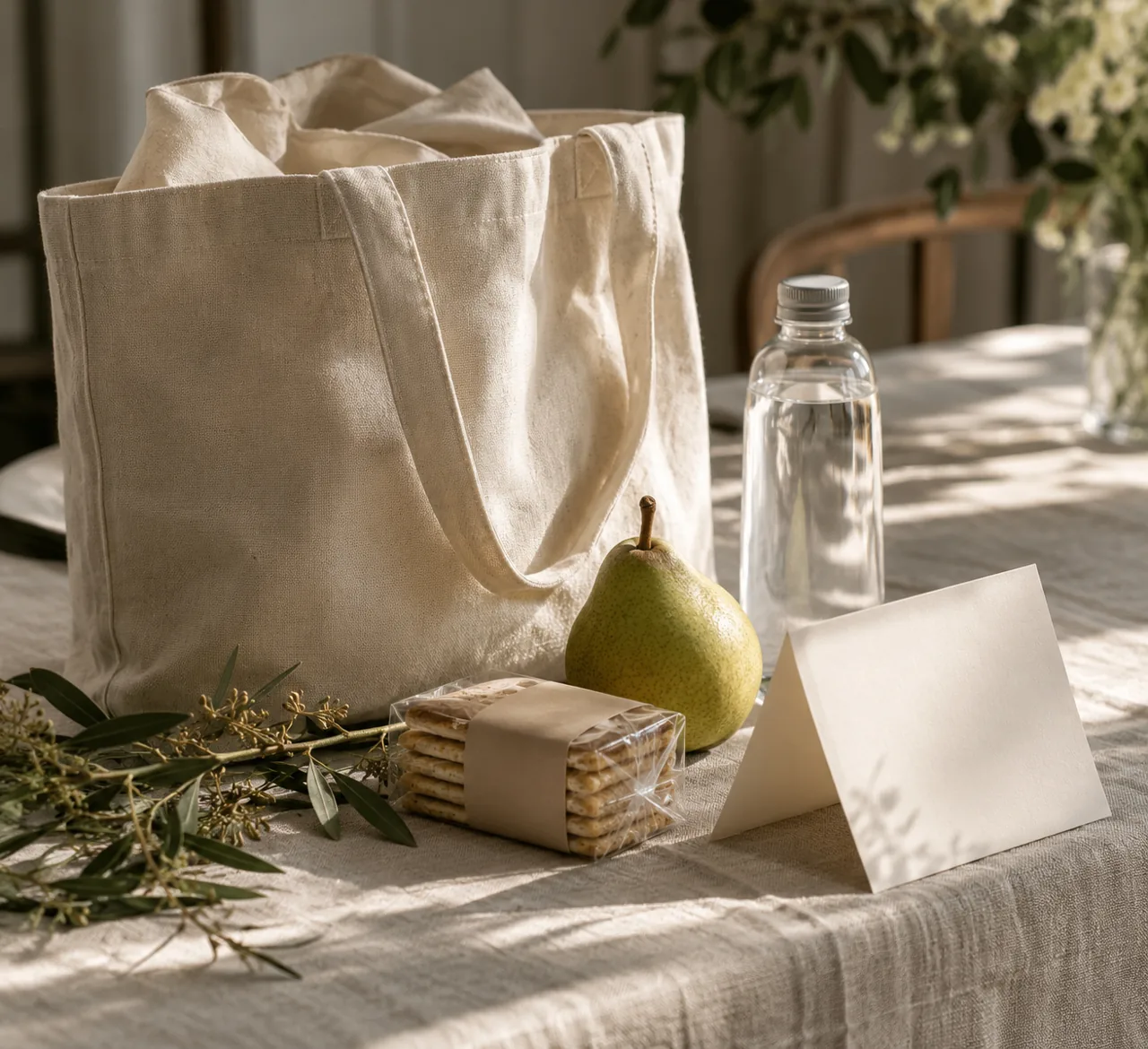
The best wedding welcome bag helps guests settle in: drinking water, a simple snack, clear event information and perhaps one small local detail. Start with what someone needs after traveling, then add personality. A welcome gift is optional hospitality, so it should never compete with reliable directions, a comfortable arrival or a meal you have promised to host.
Before buying anything, decide who receives a bag, where it will be delivered and how guests will carry it home. One bag per room may be practical, but room arrangements change. A central pickup point can be easier than individual hotel delivery when guests stay in several different places.
Begin with information guests can actually use
Include a readable itinerary with dates, local times, addresses and transport arrangements. Distinguish hosted events from optional suggestions. If a shuttle leaves at a fixed time, state the departure point rather than writing only the venue's name. Include a contact who will be available while you are getting ready.
Print essential details even if you also use a QR code. Phones lose charge, roaming can be expensive and not every guest wants to open another website on arrival. Check the route yourself and confirm that the address takes people to the correct entrance.
For a destination celebration, add one or two nearby food options, a useful shop and a note about the immediate area. Avoid turning the insert into a travel brochure. Guests mainly need to know how to arrive, where to be next and who can answer a practical question.
Choose practical food and drink
Pick sealed snacks that tolerate the expected temperature and do not need refrigeration. A savory option and something lightly sweet provide a modest choice without filling the bag. Keep original labels visible so guests can read ingredients and decide what suits them.
Do not describe a selection as allergy-safe unless you can substantiate that claim. Even a thoughtful gift may be unsuitable for some people. Offer guests a simple way to decline food, and keep dietary questions separate from public room lists or display labels.
Water can be useful, but consider access and transport. If the hotel offers a convenient refill point, a clearly marked water station may be more efficient than carrying heavy bottles between properties. Reusable bottles only make sense when guests can use them and the quality justifies keeping them.
Add one local or personal detail
A local biscuit, a small map annotated with your favorite walk or a postcard-sized illustration can create a sense of place. Tell guests why you chose it in one sentence. A meaningful explanation often makes an inexpensive item feel more considered than an assortment of anonymous trinkets.
Choose something easy to pack. Large jars, fragile glass and awkward shapes can become a burden for air travelers. Liquids may create additional packing complications, so let guests enjoy them during the stay rather than assuming they can take them home.
Our personalized favors guide explores how useful keepsakes differ from objects designed mainly for a photograph. For welcome bags, the contents should support arrival first; the souvenir is a secondary pleasure.
Personalize the note rather than every object
A warm handwritten line can make an ordinary paper bag feel welcoming. Thank guests for making the journey, explain what you look forward to sharing and keep the tone relaxed. There is no need to put your names and wedding date on every wrapper.
If you want a visual link to the celebration, repeat one paper color, ribbon or small motif from the invitations. This creates coherence without commissioning a complete product collection. A simple monogram can be reserved for a tag that guests can recycle separately.
Avoid printing private guest information on the outside. A first name or room reference used by hotel staff may be enough for distribution, but confirm the process with the property. Never leave a public list of names and room numbers beside the pickup table.
Set a realistic assembly budget
Count the container, tissue, tags, printing, delivery and replacement items alongside the contents. A small unit price multiplied across rooms can grow quickly. Build one sample and weigh it before ordering the full quantity.
As an illustrative exercise, a bag with a $2 container, $3 snack, $2 drink and $1 printed insert totals $8 before tax or delivery. These are planning assumptions, not current market prices. Your actual costs depend on suppliers, location and quantities.
Keep a few spare inserts for guests who lose theirs, but do not buy a large surplus of personalized products without a use for them afterward. Our planning checklist helps place assembly and delivery in the final-month schedule.
Packaging that works beyond the picture
Paper bags are easy to label and fold flat. Fabric totes may be useful when they are sturdy and minimally branded, but an inexpensive tote is not automatically a sustainable choice. Consider materials, likely reuse and the amount of packaging inside.
Avoid loose glitter, confetti and elaborate knots that guests must dismantle. Place heavier items at the bottom and keep food separate from scented products. If you include a candle, remember that some properties prohibit its use in guest rooms.
Ask the hotel about storage space, delivery deadlines and handling fees. Give staff a clear count and a contact person. Do not arrive with unannounced boxes and assume distribution is included in room service.
A useful packing checklist
- Final itinerary with exact addresses and local times.
- One or two sealed snacks with ingredient labels.
- Water or clear directions to drinking-water access.
- A short welcome note and available contact.
- One optional local detail that travels easily.
- Packaging that guests can open, carry and dispose of simply.
Budget-friendly alternatives
A shared welcome table can offer snacks, maps and itineraries with less packaging. Guests take what they want, and you avoid guessing room occupancy. Place it where someone can maintain it and confirm that the venue permits food distribution.
For a very small gathering, a personal greeting and a printed schedule may be enough. Our intimate wedding guide offers other ways to make people feel included without creating extra events or gifts.
Frequently asked questions
Does every wedding need welcome bags?
No. They are optional. Clear communication, water and a comfortable guest experience matter more than a packaged gift.
Should we give one bag per person or per room?
Either can work. Check room arrangements and make the contents easy to share. Avoid putting one essential itinerary in a bag intended for several unrelated travelers.
What should we avoid?
Unlabeled food, fragile objects, strong scents and items guests cannot easily pack. Avoid medicines because suitability varies and a gift bag is not a medical kit.
When should bags be delivered?
Agree with the hotel or venue in advance. Deliver before guests arrive only if storage and distribution are confirmed, and appoint someone to handle changes.
Back to top ↑